/10 min read
india is training its own replacements
by Akshat Kushwaha
so fable 5.2 came out on november 9 and i've kinda not stopped thinking about it since. on anthropic's own launch table it scores 64.9% on robodojo, which is a simulated two-arm robot the model drives from camera images, and fable 5.1 was at 27.6% on the same test, so it more than doubled in one version, and gpt 6 astra sits at 29.8%. they showed it solving a puzzle cube, unscrewing a bottle cap and drawing a picture, on robotics tasks it was never explicitly trained for. it's their benchmark and they ran every model on it themselves so take it with a little salt, but a language model is getting decent with hands, that's the part that got me. pretty cool shit for a company that just paid authors $1.5 billion for downloading pirated books off libgen. (to be fair, anthropic told the court those pirated sets weren't in the training corpus of any model it released, and the judge called training on bought books fair use, but the downloading happened and they paid for it, so i'm keeping the joke.)
and it's not just robots. one engineer had fable 5.2 coordinate over 1,000 subagents for eight days and it built a prototype operating system that boots on a laptop, own kernel, drivers, login screen, installer. a thousand agents formalised the proof of fermat's last theorem in 30 hours. it designed three electronic devices from a one-paragraph prompt and all three worked without touching the electronics. and the open brain surgery thing i keep talking about is real too, an mit csail team let gpt 6 astra edit 0.016% of the weights of qwen3.5-0.8b by hand, no training, and its math-500 score went from 7.9% to 48.1%. critics pointed out the fix was mostly the model getting it to stop repeating itself till it ran out of tokens, which is fair, but the model looked inside another model and fixed it, i don't know what else to call that.
now i said recursive self-improvement is basically here and being very honest the data doesn't back me on that, not yet. multiple labs say 75 to 80%+ of their new code is written by ai (rand, october 2026), anthropic says claude "leads" 26% of its own ai r&d work as of august, up from under 1% in february, but 0% of it is fully autonomous. deepmind says it sees no meaningful acceleration in its own research speed. anthropic even says it deliberately kept fable 5.2 from picking up capabilities that would directly speed up ai development, which kinda kills my take a little. jack clark from anthropic did move his own guess for when full rsi becomes possible to 2027. so it's not here, it's just a lot closer than anyone in india is acting like it is, which is fine, my point still stands, i was just early.

and the money is insane. amazon, alphabet, microsoft and meta together guided for roughly $735 billion of capex this year, and amazon alone spent $77.3 billion in the july to september quarter. the entire indiaai mission is ₹10,372 crore over five years, which is about $1.2 billion, which is like a day and a half of amazon's spending last quarter. i did the maths twice because i didn't believe it. india has around 38,000 to 45,000 gpus onboarded for the mission (pib) and mint puts the us at around 10 million. we make nearly 20% of the world's data and host about 3% of its data centre capacity. we spend 0.84% of gdp on r&d, china spends 2.58% and the us 3.45%, and per person it's $84 against $2,827 for the us (dataful). so when i say we couldn't do anything in compute or fundamental research, that one's just the numbers.
then there's what we celebrated. in february sarvam launched sarvam 105b at the ai impact summit and the line everyone ran with was that it's one-sixth the size of deepseek r1 and competitive with it. r1 is from january 2025. that's the model that made everyone go oh, test time compute, and comparing to it a year later is like celebrating that your new phone beats a phone from two launches ago. on swe-bench verified sarvam 105b scores 45.0, below r1's 57.6, and frontier models are above 90% on that benchmark now. every number in the launch was self-reported too, forbes made that point. and sarvam's own 30b model only uses 2.4b active parameters and it's a reasoning model, so reasoning in a small model isn't the flex we're making it, that's just what models are now. i'll give them this though, it was trained from scratch in india on indian compute by a small team, and that's real, i just don't think "beats a year-old chinese model" is the headline we should be proud of while everyone else is pushing the frontier almost every month.
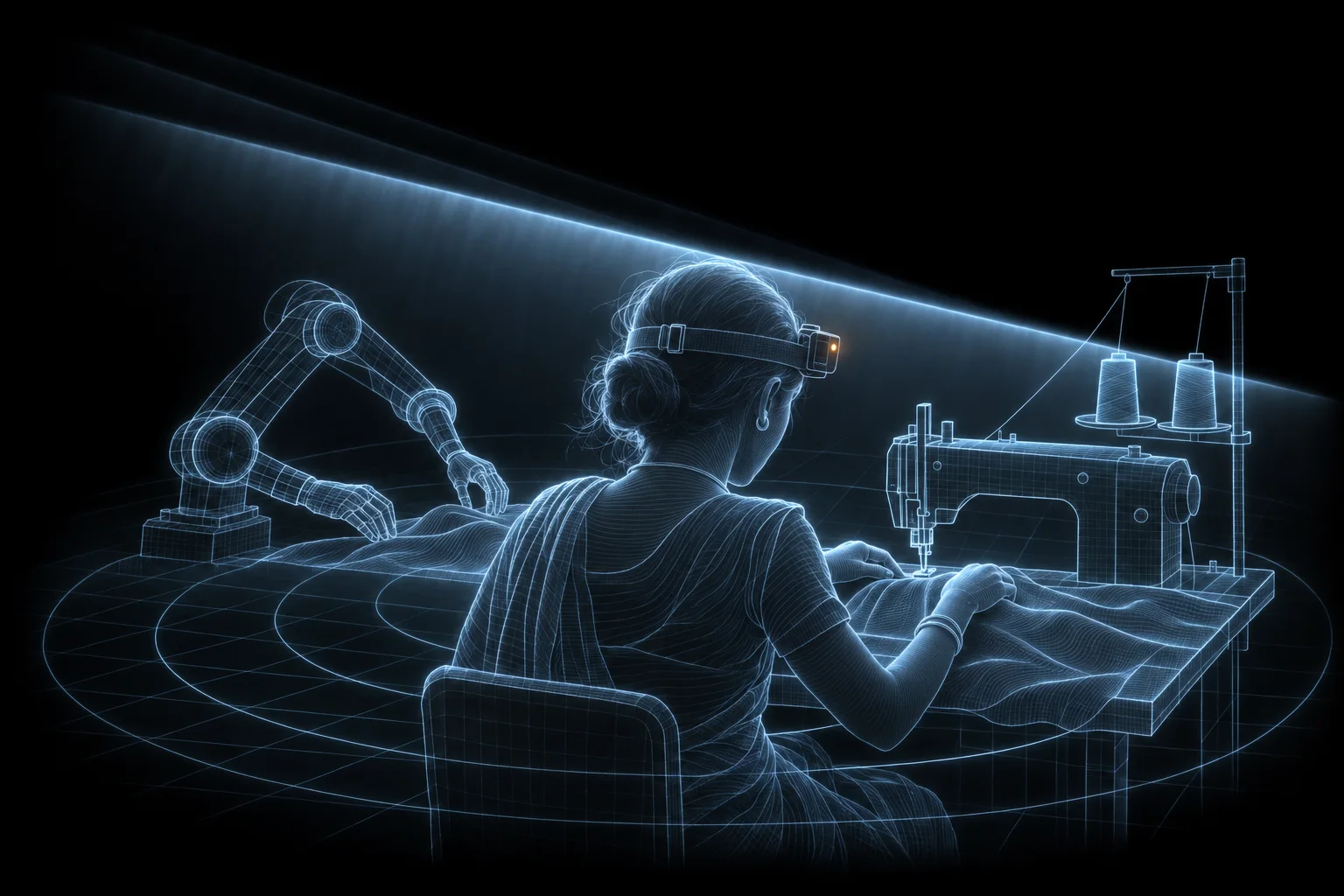
okay now the part that actually makes me sad. what india is very very good at right now is selling footage of indian people working. there's a whole industry of startups strapping cameras to workers' heads, garment workers, factory lines, grocery vendors, house help, so robots can learn what human hands do. a garment worker gets roughly ₹400 a day for wearing one. one data company pays $5 to $10 for eight to ten hours of recorded work. egolab, started by two teenagers in maharashtra, said in its own document it wants "100 million factory workers. 100 million hours of egocentric footage", it was bought by a delaware company in march and it claims tesla, boston dynamics and figure as clients. workers at the gurugram factory scroll found said nobody asked for their consent at all. in bengaluru, vendors in new thippasandra market wore headbands for instawork and some had their pay cut without warning. a stellaris report says robotics labs want 100 million to 1 billion hours of this in the next two to three years. inc42 compared it to the medical transcription work america sent to bengaluru and chennai in the 90s, which, yeah. the same people being filmed are the people the robot is meant to do the job of. we're training our own replacements and getting ₹400 for it.
and this is happening in a country where young people already can't find work. i said unemployment is at an all time high and that's not quite right on the annual numbers, the plfs 2025 puts youth (15-29) unemployment at 9.9%, down from 10.9% in 2022. but the quarterly survey has urban youth unemployment at 18.9%, a six-quarter high, and the worse number is by education. among 15 to 29 year olds, 22.3% of graduates and 24.7% of postgraduates are unemployed, against 2.3% for people who can't read. a young graduate here is about ten times as likely to be jobless as someone who never went to school. (the survey method changed in 2025 so comparing across years is messy, but that gap isn't a rounding error.) and it's not only that the jobs aren't there, a lot of us aren't employable for the jobs that are. the india skills report 2026 (ets with cii and aicte) puts overall graduate employability at 56.35%, which means roughly 44% of the people it tested didn't clear the bar, and that's the optimistic report. mercer mettl's graduate skill index 2025 tested over 10 lakh learners across 2,700 campuses and found only 42.6% employable, down from 44.3% in 2023, so more than half not. polytechnic diploma holders are at 32.92% and iti at 45.95%. even b.tech, the thing every family pushes, is 70.15% overall and drops to about 63% for mechanical and around 55% for civil. both of these come from companies that sell employability tests so they're not perfect, and they measure different things, but they point the same way, we hand out degrees to people the market won't hire, every single year, and then act surprised at the unemployment number.

which brings me to jee and the syllabus. on the official jee advanced 2026 papers, scored blind against the iit key, fable 5.1 got 358 out of 360 and gpt 6 astra got 356, and one write-up puts the human topper at 330. the exam that decides which 18,000 kids get into an iit is one a model now finishes two marks short of perfect. and we're still making engineering students write assembly for a chip from the 70s. okay maybe that teaches you something about how computers work, i'm not against it, but if the degree is mostly that and the graduate unemployment is 22%, something in the middle is broken.
also the cancer vaccine thing, i had it slightly wrong. it was paul conyngham in sydney, and it was for his dog rosie. he used chatgpt, gemini, grok and alphafold to go from her tumour's sequenced dna to a list of mutation targets and a vaccine design, and then scientists at unsw actually made the mrna. her biggest tumour shrank a lot and she's in partial remission, one tumour didn't respond, and nobody involved is calling it a cure. so it wasn't ai alone and it wasn't a human, but a guy with no biology background did a research institute's job with chatbots and a few thousand dollars of sequencing, which honestly is still the point.

now the talent thing. everyone's favourite line is that india has talent because of the population, like if 1 in 100 people is smart then 1.4 billion people should give you more smart people than the us and europe put together, right? that's the maths everyone does in their head and the data says the ratio just isn't the same here, which is the whole problem. india has about 259 researchers per million people, the us has 4,937 and china has 2,107, so the us is at roughly nineteen times our density. the stanford ai index 2026 actually puts india second in the world for the raw count of top ai authors and inventors, about 50,000 against 220,000 for the us, which sounds great until you divide by population and get around 3.5 per 100,000 people here against 64.8 in the us (that division is mine, india doesn't even show up on their per-person chart). for elite ai researchers specifically, carnegie's 2025 update has india's share by undergrad country at 4%, down from 6.2% in 2022, with about 18% of the world's people, while the us makes 13% with about 4% of the world's people and china makes 57%. so with this many people we should be drowning in talent and we're not, the density is basically nothing and the big absolute numbers are just the population doing the work. and the few who beat the funnel mostly leave, no indian institution made carnegie's top rankings in 2022 or 2025, which is why i get so annoyed when people count nri achievements on india's name, they're non-resident for a reason. it's probably not a coincidence that the dense countries spend 2 to 3% of gdp on research and we spend 0.84%, you get the density you pay for i guess. meanwhile china keeps 69% of the researchers it trains at home now.
i'm not sure what the fix is, i guess more compute and more research money than a day and a half of amazon, and some reason for the few who make it to stay. i'm writing this from india and building here so i'm obviously part of the sample, which is a weird feeling. i'll keep updating this when the numbers change, and if i got something wrong send me the source and i'll fix it,
drafted with an LLM, then reviewed and edited by me before it went up.
0 responses
leave something useful, or usefully sharp.